
Flowers
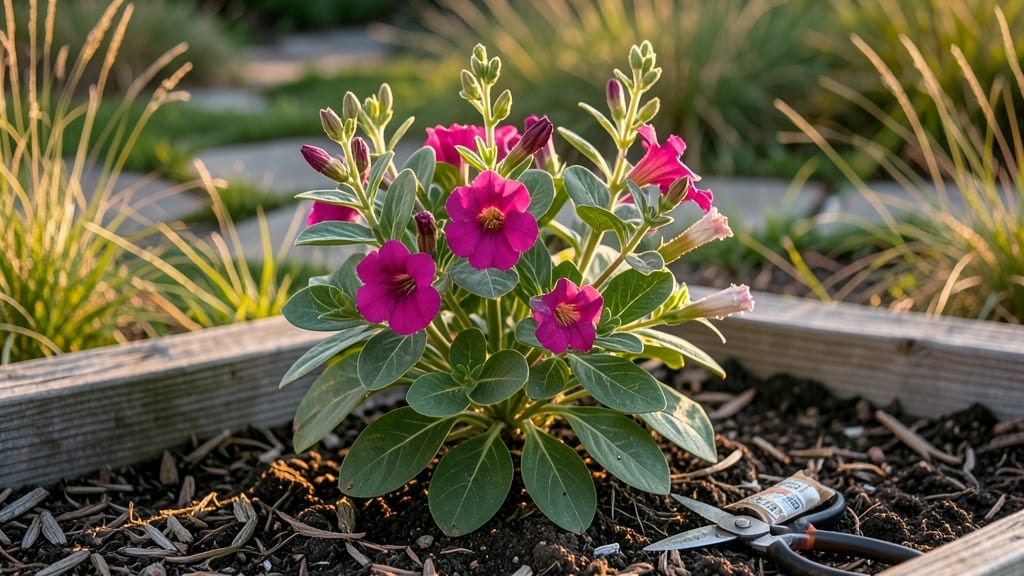
The four o'clock flower behaves like a perennial only in frost-free zones (USDA 10-11), where its tubers survive winter underground. In colder climates, it dies back annually but can regrow from seed or stored tubers if conditions allow.
The four o'clock flower's lifespan depends entirely on your climate.
In warmer regions, its tuberous roots store energy through winter, allowing it to resprout each year like a true perennial. 🌱 However, in colder zones, frost kills the above-ground growth, forcing gardeners to treat it as an annual or dig up tubers for overwintering.
This dual behavior explains why botanists classify it as a "tuberous perennial" with variable hardiness.
What sets this plant apart is its ability to self-seed aggressively in mild winters. Even if the tubers don't survive, new plants often pop up from dropped seeds the following spring. This adaptability makes it a favorite for gardeners who want vibrant blooms without the commitment of a traditional perennial.
💡 In This Article
- Four O'Clock Flower Lifespan and Cold Tolerance Explained
- How to Overwinter Four O'Clock Flowers in Cooler Climates
Four o'clock flower lifespan and cold tolerance explained
The four o'clock flower (Mirabilis jalapa) is classified as a tuberous perennial, meaning its survival strategy revolves around underground storage organs rather than woody stems. These tubers store carbohydrates and nutrients during dormancy, allowing regrowth when conditions improve.
In frost-free zones like USDA 10-11, the tubers remain viable year-round, making the plant behave like a true perennial with consistent blooms.
The key difference is that in colder regions, the tubers often fail to survive winter's freeze-thaw cycles, forcing the plant to rely on seed germination for renewal each spring. 🌱
Scientifically, the plant's cold tolerance hinges on its dormancy mechanisms. When temperatures drop below 28°F (-2°C), the above-ground growth dies back, but the tubers enter a state of metabolic dormancy. This process involves reduced respiration and water loss prevention through specialized cell structures.
In warmer climates, these tubers can remain dormant yet viable for years, while in colder zones, they often succumb to soil moisture fluctuations and temperature extremes. The plant's native range in South America explains why it thrives in tropical and subtropical conditions but struggles in temperate winters.
Here's how climate zones impact its behavior:
- USDA 10-11: Tubers survive winter naturally; plant acts as true perennial with 3-5 years of consistent growth
- USDA 8-9: Tubers may survive with protection; often treated as short-lived perennial or biennial
- USDA 7 and below: Tubers rarely survive; plant behaves as annual, relying on seed germination
The plant's seed-based regeneration is particularly fascinating. Even in colder climates where tubers fail, the plant produces thousands of seeds that remain viable for 2-3 years in the soil.
These seeds germinate when soil temperatures reach 60°F (15°C), explaining why four o'clock flowers often appear spontaneously in gardens each spring. This dual survival strategy—through both tubers and seeds—makes it exceptionally adaptable across different climates. 💫
What most gardeners don't realize is that the plant's cold sensitivity extends beyond just the tubers. The foliage and stems contain high moisture content that freezes and ruptures cell walls at 25°F (-4°C), causing irreversible damage.
This is why even partial winter survival requires careful protection methods in marginal climates. The plant's native tropical adaptations simply aren't equipped to handle prolonged freezing temperatures that occur in northern USDA zones.
Interestingly, the four o'clock flower's dormancy period varies by region. In Florida (USDA 10), tubers remain active year-round, while in California's coastal areas (USDA 9), they enter a lighter dormancy during winter's mildest months.
This regional variation explains why some gardeners in zone 9 can treat it as a perennial while others must take protective measures. The plant's ability to adjust its dormancy cycle based on environmental cues demonstrates remarkable botanical plasticity. ✨