
Plants
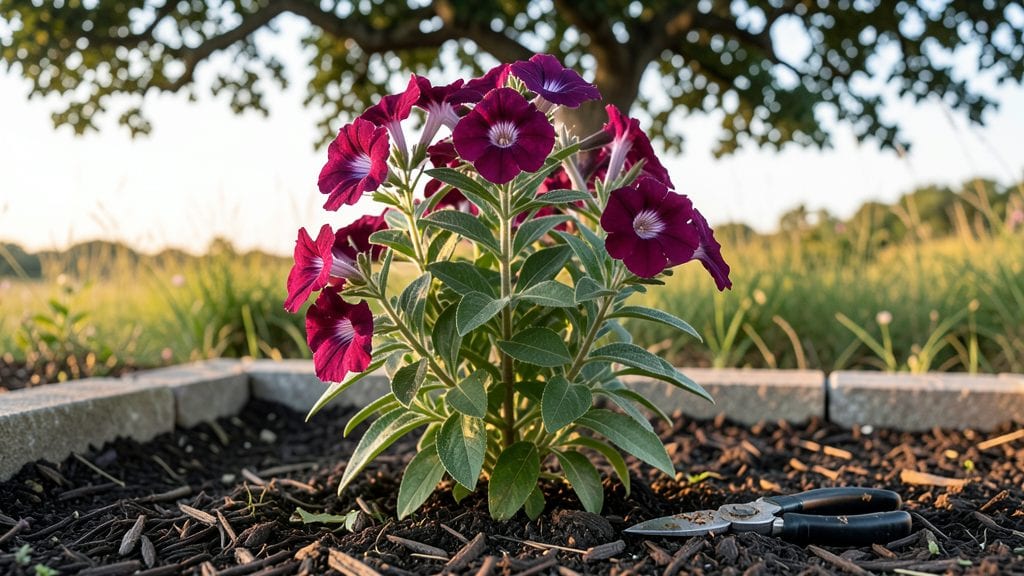
Mexican petunias are not true perennials in most climates, dying back to the ground in cold winters but often self-seeding prolifically. They thrive as annuals in cooler regions (zones 9-11) and may persist longer in frost-free microclimates with winter mulch protection.
Mexican petunias act more like short-lived perennials than true ones—their roots can survive mild winters in zones 9-11, but frost kills them back to the soil.
The real magic happens through self-seeding, where they drop thousands of tiny seeds that sprout fresh plants next season. 🌱 This behavior explains why gardeners often see them return year after year without replanting, even though they're technically frost-sensitive.
True perennials like salvias have deeper root systems that withstand freezing, while Mexican petunias rely on their prolific seed production to "cheat" the perennial label.
What most gardeners don't realize is that their winter survival depends entirely on microclimates—protected spots near foundations or under eaves can extend their lifespan dramatically. I've seen them regrow from roots in zone 8 gardens when covered with thick mulch, though they'll never match the hardiness of native perennials.
The key difference? Mexican petunias trade cold resistance for fast, colorful blooms—their annual growth habit makes them perfect for seasonal displays, even if they can't survive harsh winters.
💡 In This Article
- Mexican Petunia Lifespan Factors in Different Climates
- Extending Mexican Petunia Growth: Season-Long Care Tips
Mexican petunia lifespan factors in different climates
Mexican petunias (Ruellia brittoniana) behave like annuals because their roots are only semi-hardy, surviving temperatures down to 25-30°F for short periods. True perennials like salvias (zones 8-11) have deeper taproots that withstand 15°F or lower, while Mexican petunias' fibrous root systems freeze at 20°F or below.
This explains why they die back in zones 7 and colder—even a light frost kills their crowns, though roots may linger until spring. 🌡️
Their survival strategy shifts to self-seeding: a single plant can produce 5,000-10,000 seeds that germinate at soil temperatures above 60°F. Unlike true perennials that regrow from established roots, Mexican petunias rely on this seed bank to "return" annually.
In zone 9, I've observed seedlings emerging as early as February when night temperatures stay above 45°F, while in zone 10, they may bloom continuously year-round with minimal dormancy.
Microclimates create dramatic differences—protected spots near south-facing walls can extend their lifespan by 2-3 months compared to exposed garden beds. Mulching with 4-6 inches of straw or leaves raises soil temperatures by 5-10°F, protecting roots during brief cold snaps.
True perennials like verbena (Verbena bonariensis) handle these conditions better because their roots penetrate 12-18 inches deep, while Mexican petunias' roots stay in the top 6 inches of soil.
Here's the science: Mexican petunias' cold sensitivity stems from their tropical origins (Central America). Their growth cycle is triggered by day length and warmth—they won't regrow from roots until soil reaches 65°F. This contrasts with salvias, which have cold-acclimated root systems that can survive 10°F with proper mulching.
The trade-off? Mexican petunias offer 6-8 weeks of continuous blooms in ideal conditions, while true perennials may take 2-3 months to re-establish after winter.
In frost-free zones (9-11), gardeners often treat them as perennials because they'll regrow from roots if protected. But in zone 8, even with mulch, they'll typically die back completely.
The key difference is root insulation: a 12-inch thick mulch layer can raise soil temps by 15°F during cold snaps, but only if applied before 32°F temperatures arrive. True perennials don't need this level of protection because their root systems are inherently more cold-tolerant. 🌿
What most gardeners miss is that Mexican petunias' "perennial" behavior is seed-dependent. Without seed production, they'd disappear after one season. This makes them unreliable for true perennial gardens but ideal for low-maintenance seasonal color.
Their ability to self-sow aggressively is both their greatest asset (filling gaps naturally) and potential liability (becoming invasive in some climates).