
Flowers
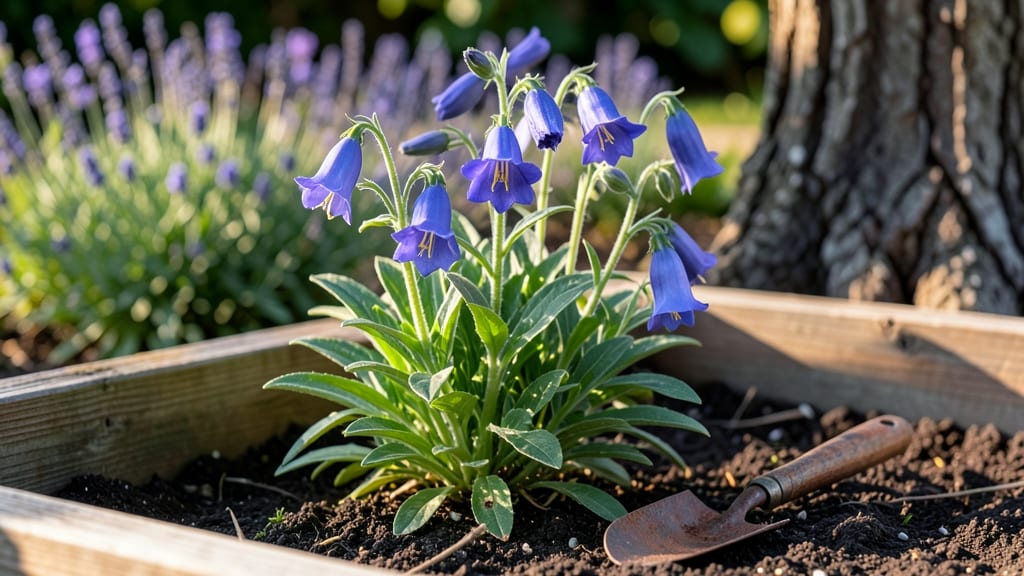
Canterbury bells are not perennial in most climates, dying back to the ground each winter and returning only in frost-free zones (USDA 5-9). Their biennial nature means they bloom profusely in their second year before fading, requiring replanting annually in colder regions.
Canterbury bells behave more like short-lived perennials or biennials—they focus all their energy on producing stunning flowers in their second year before naturally declining. 🌸 In colder zones (USDA 1-4), they’ll completely die back unless you treat them as annuals or move them to containers for winter protection.
The key to keeping them around longer is understanding their growth cycle: they prioritize blooming over survival, which is why they fade after their peak season. Many gardeners swear by cutting back spent blooms to encourage a second, smaller flush of flowers later in the season.
If you're in a milder climate (USDA 5-9), you might get lucky with self-seeding—they’ll drop seeds that sprout the following spring, giving you a fresh batch of plants.
However, these seedlings often produce weaker blooms than the parent plant, so replanting from cuttings or buying new starts is usually more reliable for consistent, show-stopping displays.
💡 In This Article
- Canterbury Bells Lifecycle: Why They Die Back Each Winter
- Extending Canterbury Bells Season: Planting and Care Tips
Canterbury bells lifecycle: why they die back each winter
Canterbury bells (Campanula medium) follow a biennial growth pattern, meaning they complete their life cycle in two years rather than surviving indefinitely like true perennials.
The first year focuses on developing a strong taproot system (reaching 12-18 inches deep) and a rosette of leaves, while the second year is dedicated entirely to flowering—often producing 30-50 bell-shaped blooms per stem. This energy shift explains why they die back after blooming, as their resources are exhausted.
Unlike true perennials like foxgloves (which regrow from underground rhizomes), Canterbury bells lack persistent storage organs, making them vulnerable to cold.
The real trigger for dormancy is temperature drops below 25°F (-4°C), which signals the plant to halt growth and conserve energy.
Their shallow root systems (typically 6-10 inches deep) are particularly susceptible to freeze-thaw cycles, which can cause root rot or desiccation. 🌱 In contrast, delphiniums (true perennials) develop deep, woody crowns that survive winters in USDA zones 3-8, while Canterbury bells behave more like biennial vegetables (e.g., carrots or onions), which also die after fruiting.
The key difference is that Canterbury bells don’t produce viable seeds until their second year, unlike annuals that complete their cycle in one season.
Here’s what’s actually happening botanically: Canterbury bells prioritize reproductive success over survival—a strategy called "semelparity" (big-bang reproduction). Their flowers contain nectar-rich structures that attract pollinators, but this metabolic investment leaves little energy for winter survival.
True perennials like foxgloves allocate resources to both reproduction and underground storage, allowing them to regrow year after year. This explains why Canterbury bells often bolt (go to seed) prematurely in hot summers, as they’re genetically programmed to focus on flowering before dying.
Cold sensitivity varies by cultivar, but most commercial varieties (e.g., 'Telephone White', 'Blue Clocks') struggle in USDA zones 1-4 unless given winter protection. The root collar (where roots meet stems) is the most vulnerable part—if it freezes, the entire plant dies.
In milder zones (5-9), they may resprout from basal buds near the soil line, but this is unreliable compared to true perennials. 💫 For comparison, foxgloves can withstand -20°F (-29°C) thanks to their thick, fleshy roots, while Canterbury bells typically tolerate only 10-15°F (-12 to -9°C) without damage.
What most gardeners don’t realize is that Canterbury bells often self-seed aggressively in frost-free zones, creating a false impression of perennials. These seedlings, however, inherit weaker root systems from the parent plant, leading to smaller blooms and shorter stems (often 12-18 inches tall vs. 24-36 inches for first-year plants).
To maintain vigor, many experts recommend replanting from cuttings every 2-3 years, mimicking their natural biennial cycle while avoiding the decline in flower quality.
The takeaway? Canterbury bells are not perennial by design—they’re evolutionary specialists in short-term, high-impact flowering. Their lifecycle mirrors that of biennial herbs like parsley or celery, which also die after fruiting.
For gardeners in cold climates, treating them as short-lived perennials (with winter protection) is the best compromise, while those in warmer zones can exploit their self-seeding habits for low-maintenance displays. 🌿