
Plants
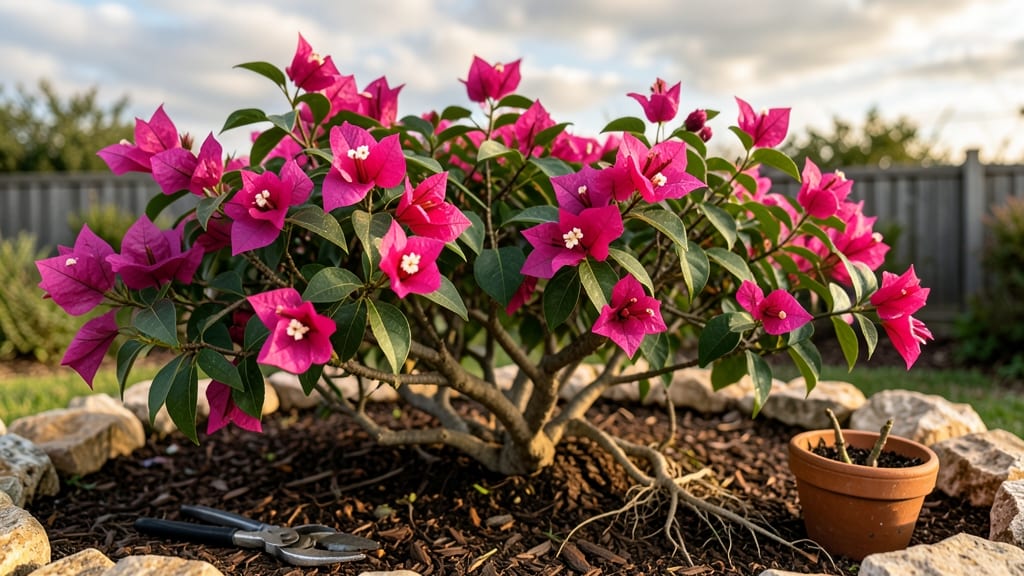
Bougainvillea plants are not perennial in cold climates—they thrive as tender perennials only in USDA Zones 10-12, where they survive year-round. Outside these zones, frost will kill their stems, though roots often endure, allowing regrowth with proper winter care.
Bougainvillea's tropical origins explain why they can't handle freezing temperatures—anything below 30°F (-1°C) will damage or kill their woody stems. 🌡️ In milder climates like Zones 9-10, they may survive winters but often with significant dieback.
The good news? Even in colder regions, their hardy root systems can regenerate when spring arrives, making them "annuals" that return stronger each year with the right care.
What sets bougainvillea apart is their resilience—unlike many tropical plants, they don't just die in cold snaps. Their roots often remain dormant underground, ready to sprout new growth when temperatures rise.
This adaptability is why gardeners in Zones 7-9 can still grow them successfully, though they'll need protective measures like mulching or overwintering indoors.
💡 In This Article
- Bougainvillea Cold Hardiness Zones Explained
- Winter Care Tips to Revive Bougainvillea Annually
Bougainvillea cold hardiness Zones explained
Bougainvillea's cold tolerance hinges on their native tropical habitat, where temperatures rarely drop below 50°F (10°C). The plant's stems contain vascular tissues that freeze and rupture when exposed to 30°F (-1°C) or lower, which explains why they're classified as tender perennials in Zones 10-12.
Here's the science: their cell walls lack the antifreeze proteins found in cold-hardy plants, causing ice crystals to form and burst cell membranes in freezing conditions.
The key distinction lies in root survival versus stem damage. While stems die back at 28°F (-2°C), the root systems often remain viable down to 20°F (-7°C) if protected by mulch or soil insulation.
This is why bougainvillea can regrow each spring in Zones 9-10—roots act as biological memory, storing energy for regrowth. Coastal areas in these zones benefit from moderating ocean breezes that prevent hard freezes, while inland regions face higher risks of stem death.
Zone 9 represents the northern limit where bougainvillea can survive winters with minimal protection. In Zone 9a (20-25°F/-7 to -4°C), plants may experience some dieback but often recover, while Zone 9b (25-30°F/-4 to -1°C) offers better survival rates.
The critical threshold is 28°F (-2°C))—below this, even protected plants risk significant damage. This explains why coastal California gardens thrive with bougainvillea while inland Arizona locations often require winter protection.
Microclimates create dramatic variations within zones. A bougainvillea in a sheltered microclimate of Zone 8b (15-20°F/-9 to -7°C) might survive winters if planted against a south-facing wall, while just 50 feet away in an open area, it would likely die back completely.
The plant's thin bark offers no insulation, making it vulnerable to radiant frost that forms on exposed surfaces at night.
What most gardeners don't realize is that bougainvillea's growth cycle actually benefits from winter dormancy. The plant undergoes a natural process called vernalization—a cold period that triggers spring regrowth. This explains why properly overwintered plants often produce more vigorous blooms the following season.
The trade-off is that each freeze event weakens the root system slightly, which is why bougainvillea in colder zones require annual rejuvenation pruning.
For visual reference, compare bougainvillea's cold tolerance to other tropical plants: hibiscus (Zone 10) and plumeria (Zone 11) have similar limitations, while more resilient tropicals like bird of paradise (Zone 9) can handle slightly cooler temperatures.
The difference lies in bougainvillea's thinner stems and less insulated root zones—both evolutionary adaptations to their native Brazilian scrubland where seasonal temperature swings are minimal.