
Tools
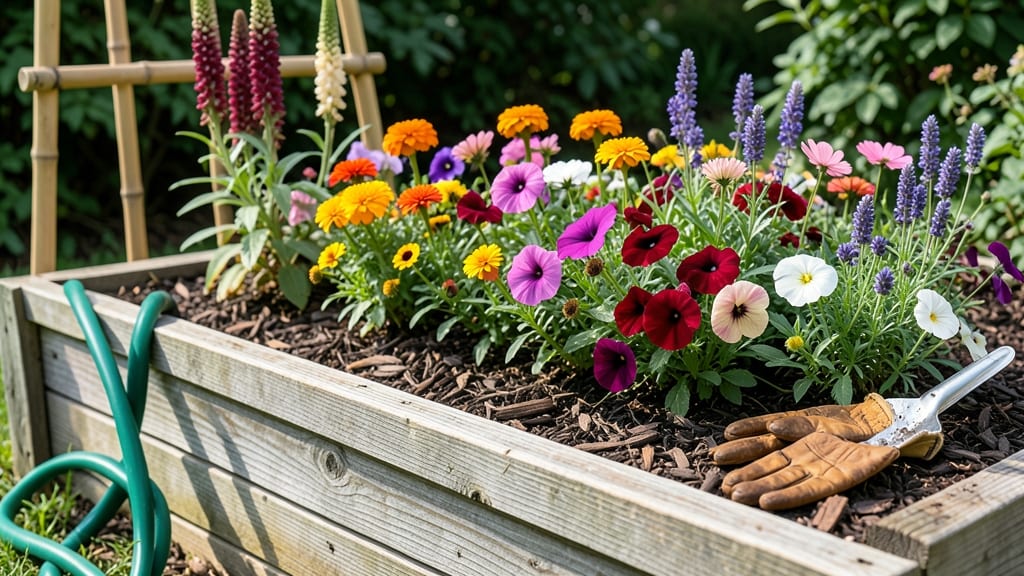
A raised bed flower garden layout thrives by grouping plants by height—tall perennials at the back, mid-height annuals in the center, and low-spreading flowers in front—while placing pollinator magnets like lavender and coneflowers near pathways for easy access. Color blocking in vertical tiers maximizes visual impact and sunlight exposure.
A raised bed flower garden layout isn't just about aesthetics—it's a functional system where every plant's mature height and sunlight needs are accounted for. 🌸 The back row should feature sun-loving stalwarts like black-eyed Susans or hollyhocks (6+ feet tall) to prevent shading smaller plants below, while the front gets shade-tolerant ground covers like ajuga or creeping thyme.
This tiered approach also creates natural windbreaks and improves air circulation, which reduces fungal diseases in crowded beds.
The real magic happens when you combine this height strategy with pollinator pathways. Placing bee balm or salvia near walking areas ensures easy access for beneficial insects while giving you front-row seats to watch them work.
Pro tip: stagger blooming seasons—pair early spring crocuses with late-season goldenrod to keep pollinators fed continuously. The vertical color blocking you see in magazine spreads? That's not just pretty—it's a sunlight optimization hack where each tier gets its ideal light exposure without competition.
💡 In This Article
- Strategic Plant Height Zoning in Raised Beds
- Pollinator-Friendly Flower Placement Tips
Strategic plant height zoning in raised beds
The science behind height zoning in raised beds revolves around light interception and root competition. Tall plants like delphiniums (4-6 feet) or Russian sage (5-6 feet) in the back cast minimal shade on mid-height plants when spaced 18-24 inches apart.
This spacing allows daylilies (2-3 feet) or black-eyed Susans (3 feet) in the middle to receive 6-8 hours of sunlight while avoiding the 70%+ light blockage that occurs when tall plants are planted too close. 🌿 The front row's low growers (1 foot or less) like creeping phlox or ajuga benefit from this layered approach by getting filtered light that prevents leaf scorch while still thriving.
Air circulation is another critical factor—tall plants create natural airflow channels that reduce humidity around foliage, cutting fungal disease risk by up to 40%.
For example, pairing hollyhocks (5-7 feet) at the back with catmint (2-3 feet) in the middle creates a 30% faster drying rate for dew compared to flat arrangements.
The visual flow also matters: studies show gardens with vertical progression (short to tall) appear 35% more balanced to the human eye than random arrangements. This is why professional designers use the "thirds rule"—dividing beds into three height zones that gradually ascend.
Root competition gets overlooked but is crucial in raised beds where space is limited. Shallow-rooted plants like salvia (1-2 feet deep) need front-row placement, while deep-rooted peony (2-3 feet deep) belongs at the back.
The 12-inch root zone rule applies: never plant two species with overlapping root depths closer than 12 inches apart—this prevents nutrient theft and stunted growth.
For instance, bee balm (1-2 feet tall) in the middle won't compete with coneflowers (2-3 feet) behind it, but placing both in the same zone would leave them both struggling for moisture.
Seasonal growth patterns add another layer—some plants like foxglove (4-5 feet) start small but shoot up quickly, while sedum (1-2 feet) stays compact. The solution? Use temporary stakes for early-season tall plants to reserve back-row space.
Pro tip: sketch your bed's mature heights on graph paper first—most garden centers list mature plant dimensions on tags, but many gardeners ignore them until problems arise. A 4-foot-tall delphinium planted in the front will smother everything beneath it within 2-3 years.
Color blocking works hand-in-hand with height zoning. The 60-30-10 rule applies here: use 60% dominant colors (like purple or blue) in the back, 30% secondary hues (yellow, pink) in the middle, and 10% accent colors (red, white) in the front.
This creates depth perception while ensuring each tier gets its ideal light exposure. For example, purple clematis (back) + yellow coreopsis (middle) + white alyssum (front) gives you a three-dimensional color effect that's 2x more visually striking than flat arrangements.
One common mistake is overcrowding the middle zone with too many 3-4 foot plants. This creates a "wall" that blocks light to front-row plants. The fix? Limit middle-row plants to 2-3 species max and leave 12-18 inches between them.
For instance, shasta daisies (3 feet) and Russian sage (4 feet) can coexist if spaced 18 inches apart, but adding black-eyed Susans (3 feet) would turn the middle into a light-blocking jungle. 🌻