
Plants
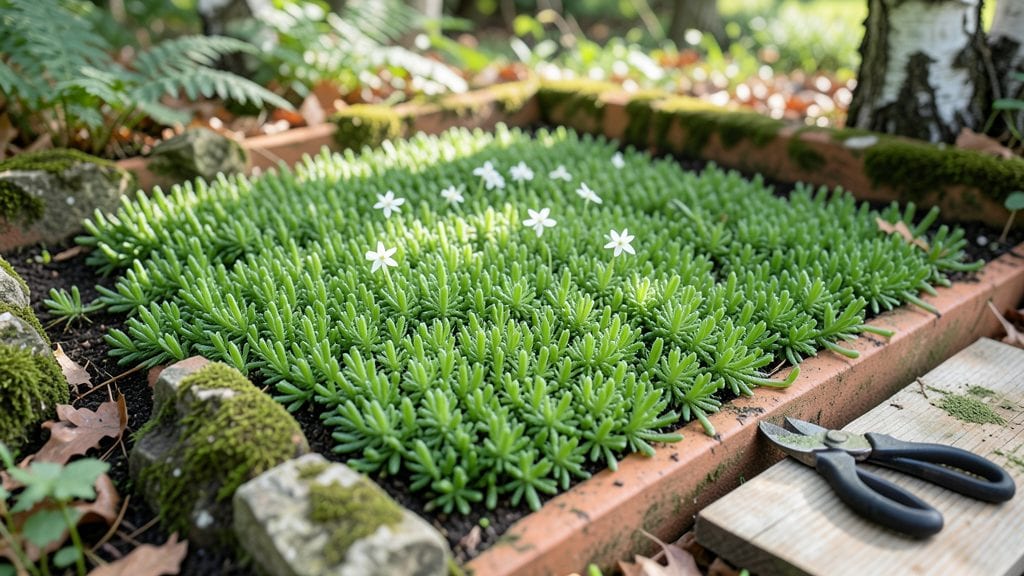
Irish moss isn't a perennial plant—it's a cold-tolerant Chondrus crispus algae that thrives in coastal waters but dies back when temperatures drop. Though its spores regenerate annually in ideal conditions, this marine lifecycle differs fundamentally from true perennials.
This algae's survival strategy relies on its ability to release spores that persist through winter, allowing regrowth when conditions improve. 🌊 Unlike land perennials that regenerate from roots, Irish moss depends entirely on its marine environment—freezing temperatures kill the plant, but the spores remain dormant until spring tides bring them back to life.
Many gardeners confuse its annual regrowth with perennial behavior, but biologically, it's a completely different lifecycle.
For those curious about its culinary uses, Irish moss is prized in traditional recipes like Irish moss pudding, where it acts as a natural thickener.
The key to sustainable harvesting is timing—collect it during low tide when it's exposed but still vibrant, then dry it thoroughly to preserve its thickening properties for months. Always check local regulations, as some coastal areas restrict harvesting to protect fragile ecosystems.
💡 In This Article
- Marine Algae vs. Land Perennials: Why Irish Moss Defies Plant Categories
- Cultivating Irish Moss for Cooking: Harvesting and Storage Tips
Marine algae vs. land perennials: why Irish moss defies plant categories
True perennials like asparagus or lavender survive winter by storing energy in underground structures (rhizomes, tubers, or roots), allowing them to regrow each spring.
Irish moss, however, operates on a fundamentally different lifecycle—it's a red marine algae that thrives in saltwater environments where temperatures rarely drop below 32°F for extended periods.
When coastal waters freeze, the plant tissue itself dies, but its tetra-spored tetrasporangia (reproductive cells) remain dormant on rocks and sediment until conditions improve. 🌊
The key difference lies in its reproductive strategy: Irish moss releases spores that can persist for months in cold water, waiting for warmer currents and sunlight to trigger germination. This process is more akin to annual plants that rely on seed banks than true perennials.
In its native habitats along the North Atlantic coast, Irish moss forms dense mats that can regrow within 2-4 weeks of thawing, creating the illusion of perennial behavior—but this is purely environmental resilience, not biological permanence.
What most people don't realize is how sensitive Irish moss is to freshwater exposure. Unlike terrestrial perennials that can tolerate brief dry periods, this algae requires consistent salinity levels (30-35 ppt) to survive.
Even a single freshwater rainstorm can kill exposed plants, which is why it thrives only in intertidal zones where ocean tides maintain its ideal environment.
This extreme specialization explains why gardeners attempting to cultivate it in freshwater ponds or aquariums typically fail—it's not a hardy perennial, but a marine specialist with very specific needs. ✨
Consider the temperature thresholds: while some land perennials can withstand -20°F winters, Irish moss begins dying at 28°F when ice forms around its delicate filaments. Its survival depends entirely on the ocean's thermal buffering—something no terrestrial plant requires.
This biological dependence on marine conditions is what makes Irish moss fundamentally different from garden perennials, despite its annual regrowth pattern fooling many into classifying it incorrectly.
The confusion stems from how we define "perennial" in gardening. Most plants in this category regenerate from living tissue, but Irish moss relies on dormant spores—a strategy more similar to seaweeds than flowering plants.
Even its texture differs: instead of woody stems or fibrous roots, it grows as gelatinous, branching filaments that can reach 6-12 inches long, perfectly adapted for wave action but not for terrestrial gardening conditions. 💫
For those interested in its culinary uses, this lifecycle explains why Irish moss must be harvested before freezing temperatures—typically between September and November in temperate zones.
The drying process preserves its agar-like polysaccharides, which thicken liquids at concentrations as low as 0.5-1%, making it invaluable in traditional desserts like Irish moss pudding.
But understanding its true nature as a marine organism—not a perennial—helps explain why it never truly "goes dormant" in the garden sense; it simply waits for the ocean to bring it back to life.