
Flowers
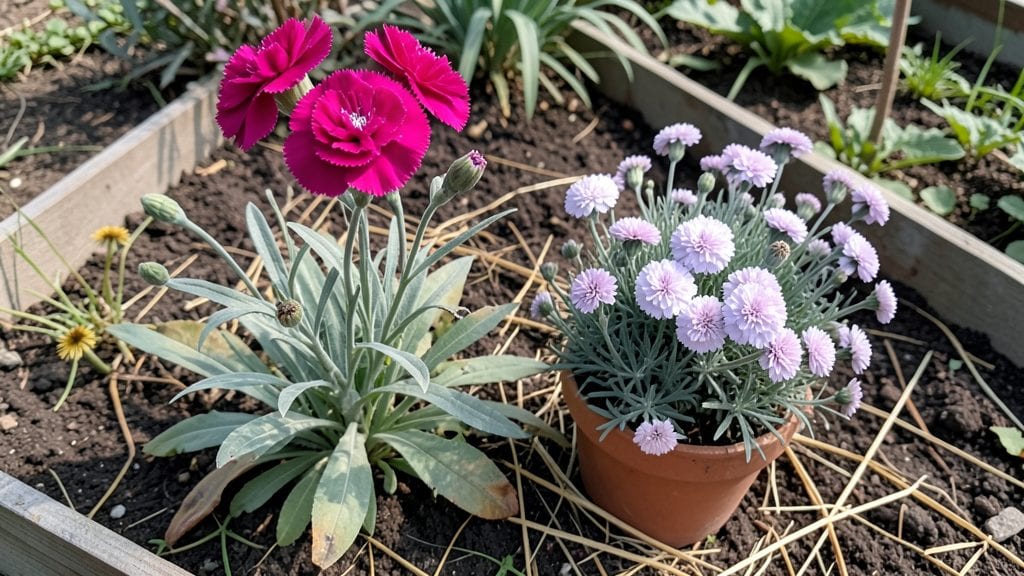
Deciding whether dianthus flowers are annual or perennial depends on your climate—most thrive as perennials in USDA Zones 3-9, but some varieties may behave as annuals in colder regions or with poor growing conditions. Proper care and winter protection can make all the difference.
Dianthus flowers' lifespan hinges on their root systems and ability to withstand winter chill. 🌱 In colder zones, varieties like Sweet William (Dianthus barbatus) often survive, while tender types such as Chinese Pinks (Dianthus chinensis) may not.
The key is mimicking their natural habitat—well-draining soil and full sun—so they can establish strong roots before winter. I've found that adding a thick layer of mulch in late fall can protect the crown from freezing temperatures, giving them a better chance to return next spring.
What's interesting is how some gardeners extend their dianthus' life by treating them as perennials even in marginal zones. For example, digging up clumps in fall, trimming the foliage, and storing them in a cool, dry place until spring can trick them into behaving like perennials.
This method works best for hardier varieties, though it requires extra effort. The payoff? Vibrant blooms year after year without replanting.
💡 In This Article
- How Cold Hardiness Zones Affect Dianthus Longevity
- Tips to Extend Dianthus Blooms Year After Year
How cold hardiness zones affect dianthus longevity
The secret to dianthus perennialism lies in their root systems and how they handle winter chill. These flowers develop a deep, fibrous root network that stores energy for regrowth. In USDA Zones 3-9, where winter temperatures rarely drop below -34°F, these roots can survive dormancy.
The key mechanism is their ability to produce antifreeze proteins—natural compounds that prevent ice crystals from forming in their cells, similar to how some fish survive Arctic waters.
Hardy varieties like Sweet William (Dianthus barbatus) have evolved to thrive in colder climates, with roots that can penetrate 12-18 inches deep to access moisture. Their foliage also contains high levels of polyphenols, which act as natural sunscreen and protect against UV damage during long winter days.
In contrast, tender types like Chinese Pinks (Dianthus chinensis) have shallower roots (6-10 inches) and lack these protective compounds, making them more vulnerable to freeze-thaw cycles.
Zone boundaries matter because they reflect average minimum temperatures over time. For example, Zone 4 (-30°F to -20°F) might support Sweet William with proper mulching, while Zone 5 (-20°F to -10°F) could handle both hardy and semi-hardy varieties.
The difference comes down to how well the roots insulate the crown—dianthus crowns need to stay above 20°F to avoid irreversible damage. In colder zones, even hardy varieties may die back to the ground but regrow from the roots if protected.
Here's what most gardeners miss: soil drainage is just as critical as temperature. Dianthus roots rot in soggy conditions, even if temperatures are ideal.
In Zone 6 (-10°F to 0°F), I've seen Cheddar Pinks thrive in raised beds with 50% sand amendment, while identical plants in clay soil failed. The science shows that well-draining soil keeps roots from freezing solid—a process called soil frost heave that can lift and damage crowns.
For comparison, consider Dianthus barbatus vs. Dianthus superbus. The former tolerates -30°F with minimal protection, while the latter (a Zone 5-8 native) needs winter mulch. The difference? Barbatus has thicker stems and more waxy foliage—both adaptations that reduce moisture loss during cold snaps.
This is why selecting the right variety for your zone isn't just about hardiness ratings but also about matching the plant's natural growing conditions.
What's fascinating is how dianthus use a two-phase dormancy strategy: first entering a light dormancy in fall to harden off, then a deeper dormancy in winter. This explains why some varieties survive -20°F but struggle with -25°F—the transition between these phases is where most damage occurs.
Understanding this helps explain why a Zone 4 plant might survive in a sheltered microclimate but fail in an exposed garden bed.
Remember: the 10°F rule applies—each zone represents about 10°F difference in average minimum temperature. A Zone 5 plant might survive in Zone 4 with extra care, but pushing it to Zone 3 risks failure.
The best approach? Start with varieties labeled for your zone, then experiment with microclimates and mulching to expand their range.