
Flowers
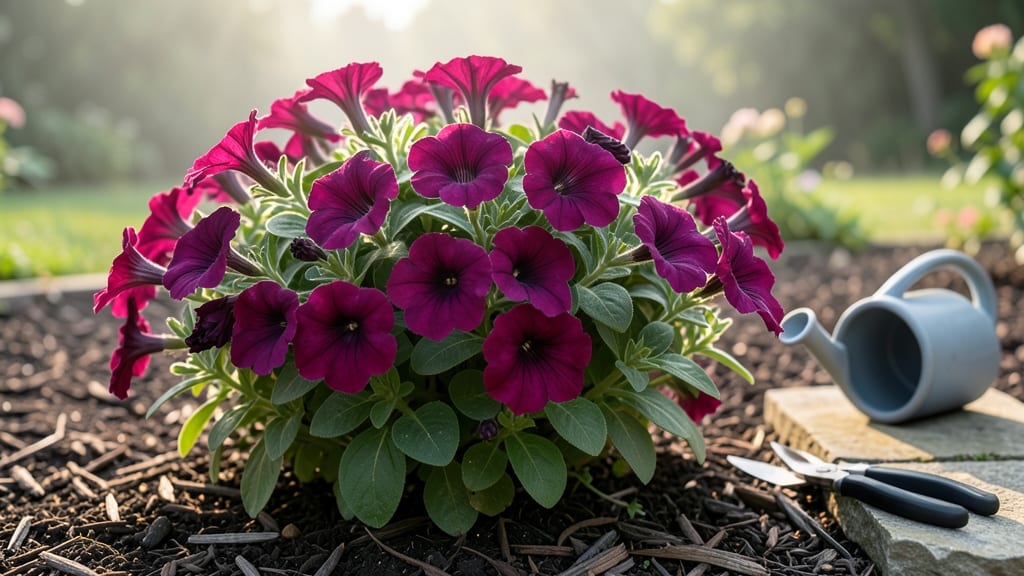
Petunias are not perennial flowers in most climates, dying back to the ground after frost and requiring annual replanting in cold regions, though they may self-seed or return in warmer zones with proper care.
Petunias thrive as annuals because their tropical origins make them extremely sensitive to freezing temperatures.
When frost hits, their delicate foliage blackens and dies, unlike hardy perennials that survive winter dormancy. 🌱 However, in milder climates like USDA zones 10-12, petunias often self-sow naturally, creating spontaneous returns that fool many gardeners into thinking they're perennials.
The key difference lies in their root systems—petunias lack the deep, insulating roots that help perennials endure cold snaps.
This isn't just about temperature tolerance; it's about their entire growth cycle. True perennials like coneflowers or lavender store energy underground to regrow each spring, while petunias complete their entire life cycle in one season.
That said, with some strategic care—like overwintering container-grown plants in a garage or choosing cold-hardy varieties—you can extend their lifespan beyond a single season in cooler areas.
💡 In This Article
- Petunia Lifespan: Why They Die in Cold Climates
- Extending Petunia Growth: Annual vs. Perennial Hacks
Petunia lifespan: why they die in cold climates
Petunias originate from South America's temperate regions, where they evolved in climates that never drop below 40°F. Their thin, fleshy stems and broad leaves lack the protective adaptations of true perennials.
When temperatures fall below 32°F, cellular damage occurs almost instantly—ice crystals form within plant tissues, rupturing cell walls and causing irreversible harm. This freeze sensitivity explains why petunias wilt dramatically after even light frosts, unlike hardy perennials that enter protective dormancy.
The key difference lies in their root systems: petunias develop shallow fibrous roots that store minimal energy reserves. True perennials like coneflowers (Echinacea) or lavender (Lavandula) grow deep taproots that penetrate 2-3 feet underground, insulating them from temperature fluctuations.
Petunia roots rarely exceed 6-12 inches depth, offering no thermal protection. Even mulch only provides 2-4°F of insulation—far too little to survive winter in colder zones.
What most gardeners miss is how petunias' tropical heritage affects their entire biology. Their rapid growth cycle (typically 60-90 days from seed to bloom) prioritizes above-ground development over root storage. This trade-off makes them spectacular annuals but ill-equipped for winter survival.
Compare this to Russian sage (Perovskia atriplicifolia), which grows slowly but builds dense root crowns that withstand -20°F temperatures—something petunias simply can't match.
Even in milder winters (USDA zones 8-9), petunias often die back completely because their metabolic processes slow dramatically below 50°F. Unlike perennials that enter true dormancy, petunias experience "chilling injury"—their leaves turn black and crispy as cell membranes break down.
The confusion arises when petunias self-seed in spring, giving the illusion of perennial behavior, but this is just nature's way of restarting the cycle rather than true overwintering.
Consider this biological comparison: petunias allocate 70-80% of their energy to flowering and foliage growth, while perennials like hostas (Hosta spp.) devote 50% or more to underground storage. This energy imbalance is why petunias can't survive winter—there's simply no reserve left to fuel regrowth.
The only exception is in frost-free zones where they can continue growing year-round, but even then, they'll eventually decline from exhaustion.
Understanding this helps explain why petunias thrive as annuals in most gardens. Their entire life strategy revolves around quick, showy blooms rather than long-term survival—a perfect example of nature's trade-offs. For gardeners in colder climates, this means accepting petunias as seasonal stars rather than perennial workhorses.