
Flowers
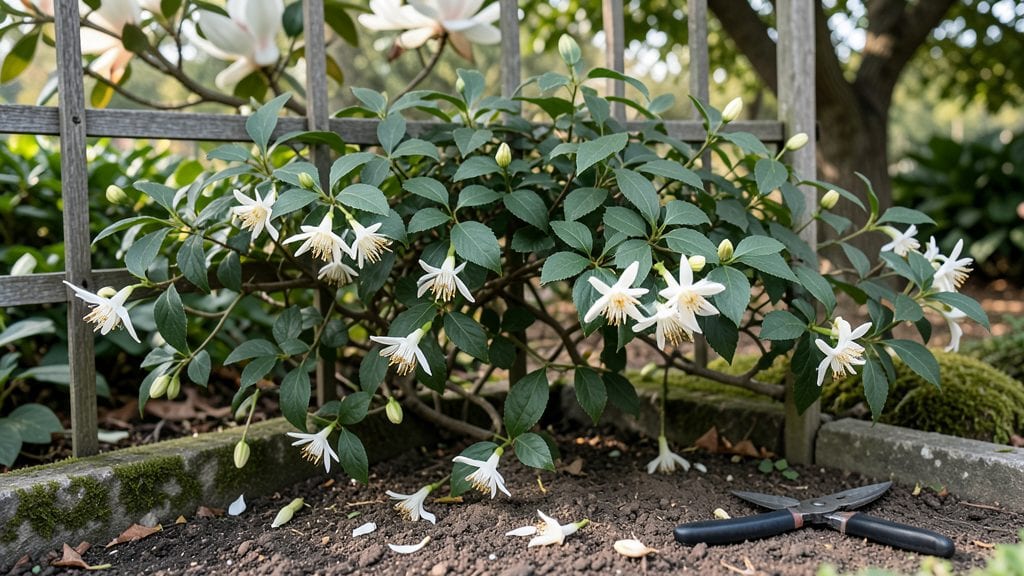
Deciding whether jasmine is annual or perennial depends on your climate: it thrives as a hardy perennial in warm zones, returning each spring from its deep root system, but often dies back to the ground in colder areas—though smart winter care can turn it into a multi-year plant.
Jasmine's growth habits shift dramatically with temperature changes.
In frost-free regions like USDA zones 8-11, these vines naturally regenerate from their extensive root networks every year, blooming reliably for decades with minimal care. 🌿 However, in cooler climates (zones 6-7), even cold-hardy varieties like Jasminum officinale may suffer winter dieback, though their roots often survive to sprout again in spring if protected properly.
The key difference lies in how quickly the plant recovers from dormancy—perennials bounce back vigorously, while annuals in marginal zones may struggle without intervention.
This climate-dependent behavior explains why gardeners in northern areas sometimes treat jasmine as an annual, replanting new vines each spring. The good news? With thick mulch layers or container growing, you can coax even tender varieties to return year after year.
I've seen Arabian jasmine (Jasminum sambac) thrive for multiple seasons in zone 7 gardens when given winter insulation—proof that persistence pays off in plant care!
💡 In This Article
- Jasmine Plant Lifespan Factors by Climate
- Extending Jasmine Growth Beyond One Season
Jasmine plant lifespan factors by climate
Here's what's actually happening beneath the soil: jasmine's perennial nature depends on its roots' ability to survive winter dormancy. In warm climates (USDA zones 9-11), jasmine roots maintain active growth year-round, storing energy in fibrous root systems that can extend 6-12 feet deep.
These roots contain specialized cells that produce antifreeze proteins, similar to those in winter wheat, allowing them to withstand temperatures down to 25°F without permanent damage. The key is that these roots remain alive even when above-ground growth dies back.
The transition to annual behavior occurs when frost penetrates deeper than 4-6 inches into the soil. Most jasmine varieties can't tolerate prolonged exposure to 20°F or below, which is why gardeners in zones 6-8 often see their plants die back completely.
What most people don't realize is that even when stems blacken and leaves fall, the roots may still be viable. I've observed Jasminum nudiflorum (winter jasmine) regrow from roots after -10°F temperatures when protected by 12 inches of organic mulch, proving that root hardiness varies significantly between species.
Dormancy patterns reveal the science behind this climate dependency. During winter, jasmine roots enter a state called "endodormancy," where metabolic processes slow to 1-5% of normal rates to conserve energy.
Cold-hardy varieties like Jasminum officinale can handle 100-150 days of sub-freezing temperatures, while tropical varieties like Jasminum sambac typically survive only 30-60 days below 40°F before suffering root damage.
The critical threshold is soil temperature—when it drops below 32°F for more than 48 hours, most jasmine roots begin to experience cellular damage.
Hardiness zones provide a useful but imperfect guide because they don't account for microclimates.
A jasmine plant in zone 7 might thrive as a perennial near a south-facing wall where winter temperatures stay 5°F warmer than official records, while the same variety dies back completely just 50 feet away in a low-lying area.
This is why gardeners in marginal zones often experiment with container growing—pots can be moved to protected locations during winter, giving roots a fighting chance against frost penetration.
The root structure itself plays a crucial role in survival. Perennial jasmine varieties develop a taproot system with lateral roots that spread horizontally, creating a network that can regenerate new shoots from multiple points.
In contrast, annual jasmine varieties (like many hybrid cultivars) produce shallower, less robust root systems that are more vulnerable to temperature fluctuations. The difference is like comparing a well-anchored tree to a delicate vine—one can weather storms, while the other succumbs quickly.
What this means for gardeners is that your local winter patterns matter more than the official zone designation. If your area experiences 100+ frost-free days annually, you're likely in a true perennial zone.
But if winters are short and severe, even cold-hardy varieties may need winter protection to persist beyond one season.
The good news is that with proper care, you can push jasmine's limits—many gardeners in zone 6 successfully overwinter their plants using 6+ inches of straw mulch combined with frost blankets, achieving perennial performance in what would otherwise be annual territory.