
Flowers
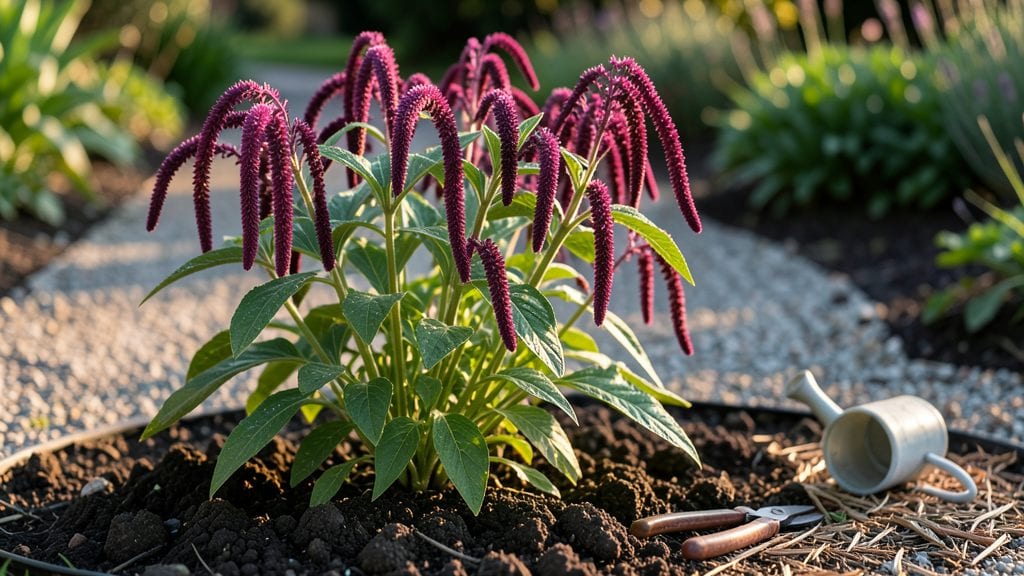
Amaranthus behaves as a perennial only in frost-free zones like USDA 10-11, where it self-seeds annually and regrows reliably each season.
Amaranthus thrives as a self-seeding annual in most regions, meaning it dies back to the ground each winter but drops seeds that sprout fresh plants in spring. 🌱 In warmer climates, however, its roots sometimes survive mild winters, allowing it to regrow—this mimics perennial behavior without being a true long-lived plant.
The key difference lies in temperature: while it may persist in zones without hard freezes, true perennialism requires consistent root survival through multiple winters, which amaranthus rarely achieves outside tropical areas.
This adaptability makes amaranthus a favorite for gardeners in transitional climates, where it can act as both an annual and a short-lived perennial depending on winter conditions.
For example, in Florida or Southern California, you might see amaranthus return year after year without extra effort, while in colder zones, it requires intentional reseeding. The plant's resilience stems from its fast growth cycle and prolific seed production, which compensates for its lack of true perennial hardiness.
💡 In This Article
- Amaranthus Growth Cycle in Different Climates
- Gardening Tips to Extend Amaranthus Lifespan
Amaranthus growth cycle in different climates
Here's what's actually happening with amaranthus in varying climates: its growth cycle hinges on temperature thresholds that trigger either seed dormancy or root survival. In USDA zones 10-11, where winter lows rarely drop below 40°F, amaranthus often persists as a short-lived perennial.
The plant's fibrous root system can endure mild freezes, allowing regrowth from the same roots in spring rather than relying solely on seeds. This behavior mimics true perennials because the plant maintains some biomass between seasons, though it's not as hardy as dedicated perennials like asparagus.
The key factor is frost depth and duration. Amaranthus roots can tolerate brief exposures to 28-32°F for short periods, but prolonged freezing (20°F or lower) kills the crown and roots.
In USDA zones 8-9, where winters dip to 15-25°F, amaranthus typically dies back completely but leaves abundant seeds. These seeds enter dormancy during cold months, germinating only when soil temperatures reach 60-65°F in spring—a process called thermodormancy.
This explains why amaranthus appears to "return" in warm zones but requires reseeding in colder areas.
What most people don't realize is how soil temperature interacts with this cycle. In tropical/subtropical regions, amaranthus grows continuously year-round, producing seeds every 60-90 days during favorable conditions.
The plant's rapid growth rate (1-2 feet per month) and prolific seed production (up to 20,000 seeds per plant) create a self-sustaining population.
Unlike true perennials that store energy in roots for multiple years, amaranthus relies on its seed bank to maintain presence between seasons—a strategy that works beautifully in frost-free environments.
Consider these climate-specific behaviors:
- Tropical zones (10-11): Continuous growth, root survival through mild winters, seed production year-round
- Temperate zones (8-9): Dies back annually but self-seeds prolifically; requires 60°F+ soil for germination
- Cold zones (7 and below): Complete die-off; must be reseeded each spring due to seed dormancy
The science behind this involves photoperiod sensitivity. Amaranthus detects day length changes, triggering flowering and seed production when daylight exceeds 12-14 hours—common in summer months. This adaptation ensures seeds mature before frost arrives in colder regions.
In warm climates, the plant's response to consistent long days results in near-continuous flowering, creating the illusion of perennial behavior through constant regeneration from seeds rather than persistent roots.
Visualize this cycle: In Florida, you might see amaranthus plants emerge in early spring from seeds that fell the previous year, grow to maturity by summer, produce seeds by fall, and then either die back or persist through mild winters—only to repeat the process.
This self-sustaining loop creates the appearance of a perennial without the biological mechanisms of true perennialism. The plant's adaptability makes it an excellent indicator of climate patterns, thriving where other annuals might struggle due to its efficient seed production strategy.