
Plants
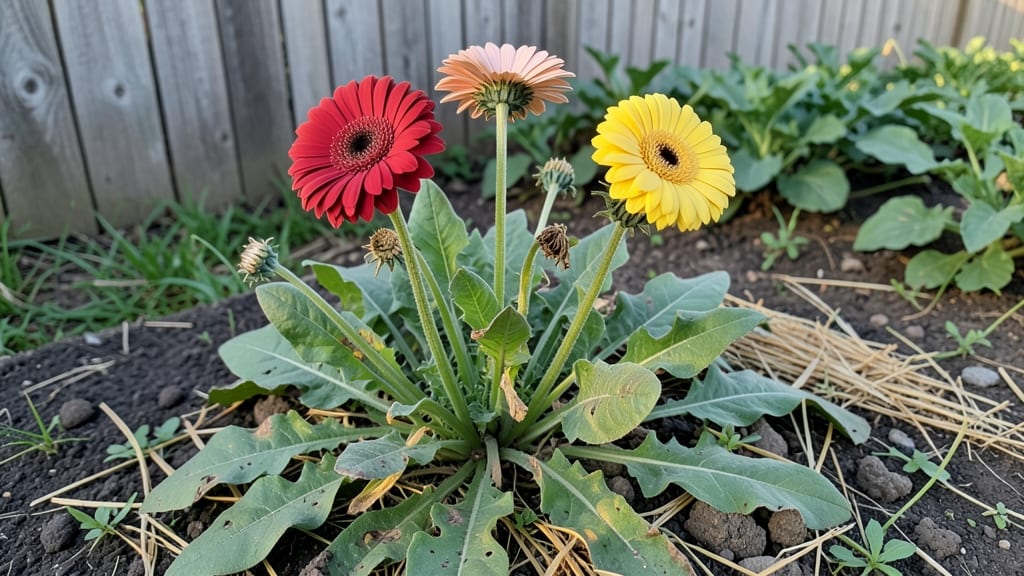
Gerberas are not perennial in most climates, requiring annual replanting in colder zones (below USDA Zone 8) as they die back to the ground each winter. In warmer regions (Zones 9-11), they may persist with proper winter protection, though their tuberous roots need insulation to survive mild frost.
Gerberas originated in tropical and subtropical regions of South Africa, so they naturally struggle with freezing temperatures.
Their tender foliage and tuberous roots can't withstand prolonged exposure below 20°F, which is why they're classified as tender perennials—they'll come back in warmer climates if given the right care. 💛 The key difference between Zones 8 and 9 is that Zone 9's milder winters (rarely below 25°F) allow roots to survive with thick mulch, while Zone 8's harsher freezes often kill them back completely.
This is why gardeners in cooler areas treat gerberas as annuals—they focus on maximizing summer blooms rather than winter survival. The good news? Even in cold climates, you can preserve gerberas by digging up tubers before frost and storing them in dry peat moss until spring.
It's all about understanding their tropical roots and working with their limitations.
💡 In This Article
- Gerbera Hardiness Zones and Freeze Sensitivity
- Extending Gerbera Lifespan in Cold Climates
Gerbera hardiness zones and freeze sensitivity
Gerberas thrive in their native South African highlands where temperatures rarely dip below 40°F—this tropical heritage explains their extreme sensitivity to frost. Their tuberous roots, which store nutrients for regrowth, contain high moisture content that freezes and ruptures cell walls at 28°F or lower.
The foliage becomes crispy and blackened when exposed to 32°F for more than 4-6 hours, while roots begin dying at 25°F. This is why Zone 8's average winter lows of 10-20°F make them non-perennial in most cases.
The USDA Zone system provides clear boundaries: Zone 9 (20-30°F lows) is the threshold where gerberas might survive winters with 12+ inches of organic mulch, while Zone 10 (30-40°F lows) offers reliable perennial growth. In Zone 8, even protected plants often lose their roots completely.
The critical period is between first frost (October-November) and last frost (March-April)—a 5-7 month window where proper insulation can mean the difference between survival and death.
What most gardeners don't realize is how tuber depth affects freeze sensitivity. Roots buried 4-6 inches deep have better insulation than shallow ones, but even then, they'll suffer in Zone 8's 10°F nights. The damage mechanism involves ice crystals forming in root tissues, which disrupts nutrient transport systems.
This is why gerberas in containers fare worse than in-ground plants—their roots have no soil mass to moderate temperature swings. 🔥
Here's how the damage progresses by temperature:
- 32-28°F: Foliage blackens but roots remain viable if warmed quickly
- 25-20°F: Root cells begin freezing; regrowth stunted next season
- Below 20°F: Complete root death; plant must regrow from seed or tuber division
The science behind this involves gerbera's C3 photosynthesis pathway, which is optimized for warm climates. Cold stress triggers metabolic shifts that deplete stored carbohydrates in tubers faster than they can be replenished. This is why winter-killed plants often show yellowing leaves in early spring—their roots can't support new growth.
The solution lies in mimicking their native climate's stable temperatures through thick mulching and windbreaks.
Consider this comparison: A gerbera tuber left exposed in Zone 8 will lose 90% of its viability after 3 consecutive nights below 20°F, while the same tuber in Zone 9 with 18 inches of straw mulch maintains 60% viability.
The difference comes down to heat retention—mulch creates a 5-10°F warmer microclimate at root level. 💫